BANNER CREDITS: RITUPARNA CHATTERJEE
A woman with the potential to make it big. It is not that she cannot: she simply will not.
PHOTO CREDITS: ANIESHA BRAHMA
The closest anyone has come to being an adopted daughter.
Showing posts with label Moments. Show all posts

Sunday, October 27, 2019

পহ্‌লা অভ্‌তার


অনেকদিন ধরে লিখব-লিখব করেও নানা কারণে এটা লেখা হয়ে ওঠেনি।

প্রথমে মাছের বাজারের ব্যাপারটা বলি। আমি মূলতঃ তিনটে জায়গা থেকে মাছ কিনি:
-      বাড়ির কাছের একটা মাছের বাজার। এখানে মূলতঃ মরাঠিরা যায়। এখানে সামুদ্রিক মাছ পাওয়া যায়, যা ওরা অসম্ভব তৎপরতার সঙ্গে কাটারি দিয়ে কাটে। “বাঙালি মাছ” বলতে পাওয়া যায় লোটে (বম্বিল) আর আমুদি (মান্ডেলি)। আমি সবরকম মাছ তৃপ্তি করে খাই, কিন্তু আমি ভালবাসলেও আঁশটে গন্ধ বাড়ির সবার মুখে রোচে না।
-      আইআইটির উল্টোদিকের বাজার। এটা বাঙালিদের আখড়া (মাছওয়ালাও বাঙালি)। এটা একটু দূরে হলেও কলকাতা থেকে মোটামুটি অনেক মাছই আসে।
-      বিগ বাজার। এটা একটু কাছে। এখানে রুই-কাতলা-পারশে তো পাওয়া যায়ই, ভেটকি-পাবদা-ট্যাংরা দিব্যি পাওয়া যায়, তবে আড়-চেতল-মৌরলা-কাজরী পাওয়া যায় না। বাড়তি সুবিধে হল এটা মলের মধ্যে, কাজেই সিনেমা দেখে বাজার করে ফেরা যায়। খুব স্বাভাবিকভাবেই এখানে বাঙালি-অবাঙালি সবাই আসে।

মাছের প্রসঙ্গে বলি, কলকাতায় থাকতে বাসাকে আমি কখনও সিরিয়সলি নিইনি। এখানে এসে মনে হয়েছে হয় কলকাতারটা বাসা নয়ত বম্বেরটা। দু’টো এক মাছ হতেই পারে না। স্বাদ সম্পূর্ণ আলাদা (ভাল-খারাপ নয়; আলাদা)। তেলতেলে বড় বাসার স্বাদ অপূর্ব – তবে ঐ, যদি মাছের তেল ভাল লাগে তবেই।

কলকাতার মানুষ বম্বে ভেটকিকে যেমন তাচ্ছিল্যের চোখে দেখে, আমার ধারণা বম্বের মানুষ কলকাতা বাসাকে নিয়ে একইরকম নাক সিঁটকোয়।

যাকগে, ঘটনায় ফিরি। এটা বিগ বাজারে। ও হ্যাঁ, এখানে গাদা-পেটি আলাদা করে কাটার রীতি নেই, সবই ঐ চাকা-চাকা। গাদা-পেটির জন্য আলাদাভাবে বলতে হয়; তাকে বলে বেঙ্গলি কাট।

যাকগে, আমি তো চিংড়ি ছাড়াতে আর কিছু বেঙ্গলি কাট করতে দিয়ে টুথপিক দিয়ে ফ্রী স্যাম্পল রেশমি কাবাব খাচ্ছিলাম। মাছ কাটা হয় আলাদা একটা ছোট ঘরে, বৈদ্যুতিক করাত দিয়ে।

এমন সময় শুনি এক বাঙালি দম্পতি মাছ কেনার চেষ্টা করছেন। বছর ষাটেক বয়স। বুঝতে পারলাম এখানে নতুন এসেছেন, কারণ “হিঁইঁইঁইঁইঁইঁইঁইঁইঁইঁ, মাছের দাম দেখেছ?”র স্টেজটা এখনও আছে। খুব সম্ভবতঃ প্রবাসী ছেলে বা মেয়ের কাছে থাকতে এসেছেন, কারণ এই বয়সে শহর ছাড়াটা বেশ অস্বাভাবিক।

তবে হিন্দিটা, ইয়ে, আমার থেকে শুধু না, আমার মার থেকেও খারাপ, অনেকটা আমার মরাঠির সঙ্গে তুলনীয়।

যাকগে, সেদিন কাতলার ভাল স্টক ছিল। একটা বড়সড় গোছের কাতলা মাছ বাছলেন ওঁরা। কাতলাকে হিন্দিতে (সম্ভবতঃ মরাঠিতেও) কাতলাই বলে, তার ওপর লেবেল ছিল। দামের ট্যাগ থাকায় কাজেই একটা স্টেপ বাঁচল। ওজনও হয়ে গেল। এবার কাটানোর পালা।

এখানে একটা কমিউনিকেশন গ্যাপ হল। মেয়েটা যত আরতি করার মত আঙুল ঘুরিয়ে চাকা-চাকা বোঝাতে চায়, ভদ্রলোক তত ক্যারাটে চপের সাহায্যে গাদা-পেটি বোঝানোর চেষ্টা করতে থাকেন। সেখানেই শেষ নয়: পাশ থেকে ভদ্রমহিলা হাত নেড়ে তারস্বরে গাদাপেটিগাদাপেটিগাদাপেটি র‍্যাপ করে চলেছেন। সে এক অভূতপূর্ব দৃশ্য।

শেষ অবধি মেয়েটাই সমাধান করল। জিজ্ঞেস করল, “বেঙ্গলি?”

ভদ্রমহিলা সগর্বে উত্তর দিলেন “বেঙ্গলি”।

“বেঙ্গলি কাট?”

এবার ওঁরা বেশ হকচকিয়ে গেলেন। যাওয়াটাই স্বাভাবিক। একে “বেঙ্গলি কাট” বলছে, তার ওপর পাশের ঘরে বৈদ্যুতিক করাত।

আমার হয়ত সাহায্য করা উচিত ছিল, কিন্তু আমি তখন বাকরুদ্ধ। হাতের টুথপিক হাতেই, সে আর মুখে উঠছে না।

কীভাবে যে বোঝা গেল তা ঠিক মনে নেই, তবে একটা সময় দেখলাম দু’পক্ষই বুঝে ফেলল বেঙ্গলি কাট আর ক্যারাটে চপ দুটো একই ব্যাপার।

আর তারপরেই মারাত্মক ব্যাপারটা হল।

কাটতে নিয়ে যাওয়ার ঠিক আগে ভদ্রলোক ধেয়ে এসে চিৎকার করে বললেন “পূঁছ কি কঙ্গী চাহিয়ে।”

এটা আমার রেঞ্জের বাইরে। আমি আখের রসের দোকানে “আঁখ কা রস দিজিয়ে” শুনেছি, “বঢ়িয়া”র বিপরীত হিসেবে “ছোটিয়া” শুনেছি, কিন্তু এটা অশ্রুতপূর্ব।

খানিকক্ষণ ভেবেটেবে একটা আন্দাজ করলাম। বড় কাতলার ল্যাজা বেশ মোটা হয়, কাজেই |||||||| জাতীয় একটা চিরুনিগোছের চর্বিভরা ব্যাপার থাকে, আমি বেশ ভালবাসি, নির্ঘাত ওঁদের বাড়িতেও কেউ না কেউ ভালবাসে। মাছ যেহেতু ল্যাজ আঁচড়ায় না, আমার ধারণা সেটাই বোঝাতে চাইছিলেন।

মেয়েটার জীবনেও খুব স্বাভাবিকভাবেই প্রথম। রুইকাতলা থাকলে বাঙালি আসবেই, কাজেই ওরা বাঙালির হিন্দি শুনে অভ্যস্ত। আমার হিন্দি বোঝা চাট্টিখানি কথা নয়, কিন্তু দিব্যি বোঝে।

কিন্তু এটা এতই আউট অফ সিলেবাস যে মাধ্যমিকে এলে নির্ঘাত ভাঙচুর হত।

এবার ভদ্রমহিলা ফীল্ডে নামলেন। মাছটা বৈদ্যুতিক দাঁড়িপাল্লায় আবার শোয়ানো হল। তারপর দেখি ভদ্রমহিলা ল্যাজার ইঞ্চি ওপরে হাওয়ায় আঙুল দিয়ে অসম্ভব গতিতে কীসব এঁকে চলেছেন। মেয়েটাও তার উত্তরে কীসব আঁকল। দু’জনেই নীরব, কিন্তু হাত চলছে ঝড়ের গতিতে। খুব ছোট টেবিলে পিংপং খেলার মত এই ডাম শ্যারাড চলল বেশ খানিকক্ষণ।

আমি হলে পূঁছ গুটিয়ে পালাতাম, কিন্তু আশ্চর্যজনকভাবে মেয়েটা বুঝল। কী বুঝল সেই জানে, কিন্তু দেখলাম ভদ্রমহিলা বেশ সন্তুষ্ট। দু’জনে পরস্পরের দিকে তাকিয়ে হাসিমুখে মাথা নাড়লেন।

ভদ্রমহিলার হিন্দিজ্ঞান সীমিত হতে পারে, কিন্তু আমি নিশ্চিত যে উনি বিশ্বের যেকোনও প্রান্তে পছন্দমাফিক মাছ কাটাতে পারতেন। মহীয়সী মহিলা।

আমার মাছ ততক্ষণে কাটানো হয়ে গেছিল। শেষ অবধি দাঁড়াইনি। আশাকরি ওঁদের পাতে সেদিন চিরুনি পড়েছিল।

Sunday, April 8, 2018

Never challenge a Maharashtrian cook


When your mother shows up, the gastronomic aspect of your life invariably takes a better turn.

Food is important, which is why I seldom outsource buying raw materials, especially vegetables and fish. For the same reason, I am typically reluctant to hire Maharashtrian cooks.

Do not get me wrong. Maharashtrian cooks are honest triers who put in every bit of their culinary skills. They try very hard, incredibly hard, but there is only so much you can do if your armoury consists of, and ends at, onions, garlic, tomatoes, and curry leaves, with coconut for variation.

You cannot blame them. They simply attempt to win a war with pea-shooters. Perhaps it is some sort of guerrilla warfare that we are too mainstream to figure out. Perhaps they can be good in an unfathomable sort of way.

The one that works at my apartment is professional but restricted in a very Maharashtrian sort of way. She toils hard without much success, but expecting quality out of her would be akin to expecting me to sing.

The matriarch of the family had tried to mentor her. She got the cook to prepare fish the proper (Bengali, in other words; machher jhol) way. The cook grumbled at not being allowed to use curry leaves but came to terms with that.

Tomatoes, of course, were another thing altogether. I have known people who seem to think I do not rate tomatoes very highly. That is an understatement. I detest, hate, loathe those squishy red orbs from hell, and even that – or any other synonymous verb, for that matter – is an understatement.

Over years I have mellowed down enough to accept tomatoes in dishes (though never in excess). The raw ones continue to remain inedible abominations.

But we are digressing. She was obviously unhappy about not being able to add tomatoes to machher jhol. She had tried to convince us, but we had stood firm: there was to be no compromise on machher jhol.

So by the time she had showed up yesterday, there was not a single atom of tomato (or even ketchup) in the household. There was not a slice of lemon, not the tiniest morsel of tamarind, not even vinegar. The yoghurt was tucked away safely. There was no contraption she could use to turn machher jhol sour.

But she won.

My mother had forgotten the raw mangoes, kept aside for superior culinary ventures. She had never expected chunks of them to show up next to fish… kajori, especially...

Wednesday, September 27, 2017

Was this Pujo or not?

Durga Pujo has died for me. Like all old men, all I live by are memories of Kolkata’s grandest festival. Pujo in Kolkata used to reek of polyester, sweat, and chilli sauce. These have been replaced by expensive polyester, failed deodorants, and chilli sauce bought from Big Bazaar.

This might come as a surprise to most, but even I used to be young at some point. I used to like the concept of Pujo at that time. We used to go to nearby Maddox Square. The chairs we acquired were significantly inadequate, so we used to seat ourselves in a substantial circle on the anticipatory newspapers. The chairs were given away to the parents who arrived late.

The evenings used to pass quickly. Was I happier at that point of my life than what I am now? I do not know.

Do I miss Durga Pujo? Not quite. I have deliberately stayed away from the city for four years at a stretch. It may have to do with my age, but struggling for hours to find a place to stand is definitely not my idea of fun anymore.

Being surrounded by cell-phones masquerading as periscopes as they approach pandals adds to that. Perhaps other quadragenarians find the idea attractive.

Today, Shoptomi, was thus just another day for me. I boarded a late-morning train from Vikhroli to Currey Road (update: I have downgraded my location from Navi Mumbai to Mumbai).

The train was empty enough for me to find a seat at Vikhroli. If you know what I am talking about, you might have let out a shriek; if you do not know, you are better off in life.

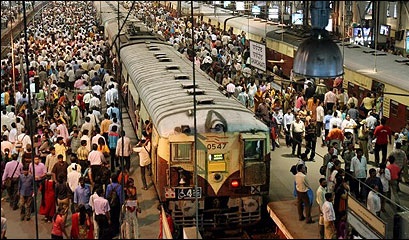
The train passed Kurla. Thanks to my new location, I do not have to participate in the Battle of Kurla anymore. Instead, I derive sadistic pleasure from watching others do the same from my vantage point inside the train.

A group of schoolchildren boarded the train at Sion. The incredibly discounted student passes invariably result in a high percentage of grateful students in the first-class compartments, and today was no exception.

Today’s batch consisted entirely of pre-teens who would, in three decades’ time, turn into brooding quadragenarians. All of them were donning dusty schoolbags and bright smiles. I could not help but wonder how much salt their toothpaste contains*.

* This is a lame joke and a blatant lie.

The children stood next to the open doors, all of them. It was obviously risky, but at their age even I was not aware of the concepts of fear unless my parents threatened me with kidnappers carrying humongous gunny-bags.

The man opposite me was not too happy about this. He was probably in his high fifties. His hair, though completely white, did not seem headed for premature disappearance anytime soon.

He yelled at the children, asking them to move away from the doors. The children, though taken aback, hesitated. A second shout did the trick. They feebly uttered something on the lines of getting down at Matunga (the next station) before retiring to their seats.

His job done, the man returned to his newspaper. Our eyes met. Instinctively, for no known reason, I did something uncharacteristic of me: I nodded, smiled, uttering “baraabar”.

But then, Pujo is about doing things you don’t do every day. Was this my Pujo? I have no idea. Probably. Probably not.

But I did reach work in a good mood. I even remembered to thank the liftman.

Monday, July 10, 2017

Training my thoughts


The authorities have recently decided to shift my workplace to Mumbai, a city significantly bigger than Navi Mumbai. This obviously added to my glamour quotient, for I travel to what Mumbaikars refer to as Town: in other words, I am part of the crème de la crème of the office-goers in this city that seems to remain alive round the clock and calendar.

But.

This affected me in two ways. First, I had got attached to my previous office. If you do not get why this bothered me, think of it this way: how will you react if you suddenly find out that Arsalan — the greatest of all pilgrimages in the history of mankind — has suddenly been serving biryani on bright blue plates? They will still serve the same manna from heaven, but will it taste the same during your first few trips?

Of course, I have a new office to get attached to and attach files to emails from. This pun would have thrived if I carried an attaché case to work, but you cannot get a touch of everything in life, can you?

The other aspect is more significant: I have to travel to work.

This may not sound very threatening for the uninitiated. I know people for whom travel is biryani. There exist people who travel every day to work and take leave to travel to random destinations and return from travel to travel to work every day again and derive happiness out of the entire process.

Yes, there are people like that.

I am not one of them. I used to walk fifteen minutes to work.

Walk. Not fifteen minutes in a vehicle of any sort. Walk.

That has changed. My biryani is no longer cardamom-free. And I cannot guarantee that this will be my last mention of biryani.

Obviously I will have to shift base, but that will take time. As for the interim period, I have to travel.

And it has to be by train. If I take the road — especially in monsoon, that selfie-inducing obnoxious time of the year — I will probably develop a bedsore of sorts.

No, it has to be by train. That bit I figured out after a day and a half of taking the road.

***

I know the tense is not consistent here. Blame it on the train journeys.

Note: When I say ‘tense’ I mean that past-present-future thing, not the state of mind you develop when the Arsalan angel tells you they will have to check whether there is mutton in the kitchen).

***

Where was I? Ah, Mumbai local trains. I am no stranger to them. They are powerful, authoritative, and omnipresent. I am aware of the advantages — speed, consistency, and availability, and more. They are the heart of the city, and more. Maybe they are even the lungs and kidneys and pancreas of the city as well.

However, the train also comes with a massive, humongous drawback: they are incredibly crowded during office hours.

How crowded?

I used to think Sealdah is crowded. It is. I have let trains pass Sealdah, casting futile, respectful glances, maintaining a safe, reasonable distance. No, I would never have managed to permeate that phalanx.

It is different in Dadar. My first attempt involved buying a ticket, going up the footbridge, and casting a futile, respectful glance at the platform, maintaining a safe, reasonable distance. I took a taxi that day and reached probably the next month.

That was what I was up against.

Mumbai Suburban Railways have three main lines. The first two are called Western (it is in the west) and Central (just east of Western). One may expect the third, the easternmost to be named Eastern. But the City That Never Sleeps decided — perhaps on one of those sleepless nights of hers — that Harbour Line would be a more appropriate name.

I live in Sanpada. My nearest station is Vashi. There are people in Vashi whose nearest station is Sanpada. This makes perfect sense in this part of the world, so my opinion is as relevant as that humble bowl of raita next to biryani.

Vashi is on the Harbour Line. The station nearest my office is Currey Road, on Central Line; it is also approachable from Lower Parel, which is on Western Line.

In other words, I was doomed.

If you look at the map, you will notice that the Harbour and Central lines meet at Kurla, and later at Sandhurst Road, Masjid, and CSMT, as CST is called these days. The M stands for Maharaj. The full name reads Chhatrapati Shivaji Maharaj Terminus.

Indeed, that literally translates to Emperor Shivaji Emperor Terminus. Before you say something on redundant words, you remember the irrelevance of the raita, don’t you?

Where was I? Ah, Kurla — the station that caters to approximately the population of New Zealand at any given point of time in office hours. If the entire population on Kurla Station at 9 AM decides to yell in unison, they will probably produce enough energy to create an earthquake in Mars.

But I had to change trains at Kurla. There was no other option.

The first bit was easy. Since Vashi is one of those ‘marquee’ stations, trains often start from Vashi. This means that on a good day you may be able to travel in first-class with both your legs inside the train. Fine, I exaggerated a bit, but you get the gist.

Unfortunately, trains do not start at Kurla. They pass through Kurla. And when they halt at Kurla, 43,224 people get off and are immediately replaced by another 72,163. Of course, these are merely eye-estimates and may have been off by a couple of digits or so…

***

Okay.

So there I was, armed with a first-class monthly ticket, an umbrella, and a paunch (among other accessories).

I had to brave what Mumbaikars have been braving since time immortal: change train at Kurla in office hours.

The first phase went without much hassle. Twenty minutes of standing is about half of what I used to do in physical education classes in school — albeit without the cell-phone trilling provokingly in my pocket.

Then came Kurla. Or rather, then came Abhishek, if you look at things from Kurla’s perspective.

One has to cross over to another platform to change trains at Kurla. There is a footbridge for that. I was foolish enough to assume it would be a cakewalk.

As things turned out, I did not cross over to the other platform. I did not need to. An ocean of humanity hurled me up the ramp. A second one shoved me towards the staircases that led to the other platform. For once I thought I would trip on my way down, but there was too much humanity around me to lose balance.

I was there before I could figure out exactly what was going on. All I had to do was turn twice.

I waded through people to reach the section designated for first-class passengers. In case you are not aware of what to look for, it is a metal pillar painted in yellow and red to match the MCC tie, blazer, and hat.

Then I prepared myself for the war, the real showdown, my Valhalla.

***

My ears were the first organs to sense the arrival. The sound was unmistakable.

Unfortunately, mine were not the only ones: 72,163 other pairs also picked up the sound.

They were on the edge of the platform before my ears could transmit the message to my brain. I had lost the first battle.

There was no way I could make it to the compartment. My only chance was the platform-change drill, but in this case everyone was in front of me.

The train left without me.

But I did not leave without a train. True, I had lost the first battle. But I had also learned a lesson, a very, very crucial one: Mumbai office-goers thrive on aggression, speed, fitness, and dexterity, none of which, unfortunately, is a part of my armoury.

So I decided to take time out.

What were my strengths? How could I put them to use to outdo these commuters and put at least one foot on the compartment?

Would puns do the trick? They came to me, one by one. I kept telling me that I could train myself to compartmentalise my flow of thoughts. I could not afford to let my resolution to be derailed. I needed to establish a platform in this realm of commuters.

No, no, no: it would not work. It seemed extremely unlikely that people would make way for me if I keep uttering these one by one.

There had to be a Plan B.

Could it be cricket history? Would they peacefully let me board the train if I lectured them on Lord Frederick Beauclerk?

No.

What about Plan C? What else was I good at?

For someone who never went to a typing school, I can type reasonably fast. Unfortunately, I use a desktop at work and was not carrying a laptop, hence… hey, what if one of them carried a laptop? What about a typewriter?

No, no, no.

Douglas Adams? Woody Allen? The Ray family? Asterix? What would it be? Map-pointing? Giuoco Piano? What? Would wolf-whistling work? What about touching the tip of my nose with my tongue?

I moved on from Plan D to E to F and beyond. Panic struck when I moved past Plan U — what if I ran out of letters?

Another train, complete with twelve compartments and 72,163 passengers, had passed by in the interim period.

Then came that Eureka moment that had once made Forbes launch into the Indian market with an assortment of vacuum cleaners and water purifiers over a decade back.

At about a quintal, I weigh about twice the average Mumbaikar. My mind raced. What was it they had taught me? Momentum was mass times velocity, was it not? If the Mumbaikar moved at twice my pace, I could counter him with twice his mass.

And I had twice his mass. And some velocity, which would actually put me at an advantage.

And when it comes to mass (I am not discussing churches here), dexterity does not matter. No, it does not. And I it had dawned upon me — exactly how to make mass count over dexterity.

So I prepared myself. How to go about it? Use my knee? Elbow? No. Go headlong. Think of yourself as a bull, a buffalo, a grotesque, ghastly minotaur, albeit a hornless one.

I knew they would go past me the moment they would hear the train arrive.

They did exactly that.

I smiled. I knew what I was going to do.

They scrambled for the door. I ambled for it.

Then, as an entire garrison attempted to squeeze itself into one gate, I acted.

I took a couple of steps and pushed myself, almost headfirst, into the back of the frailest individual I found.

He stood no chance. My mass, combined with my more-than-zero velocity, propelled myself inside the compartment. The man enjoyed the collateral benefit of being thrust into the compartment as an inseparable entity, but that did not matter.

I was there. Physics had got me there. Mechanics had got me there. Decades of red meat, oil, carbohydrates, and sugar had got me there. Utter disdain for physical exercise had got me there.

I had finally found my biryani.

***


Hang on, is it Monday train day already?

Saturday, October 24, 2015

My Durga Puja, 2015

I am agnostic to Durga Puja. I am not exactly opposed to it, but I believe in living and letting live. As long as Durga Puja (the first phrase I came across in my life that was abbreviated to DP, courtesy: Presidency College days) lets me live on my own, I do not have an issue with others celebrating. I can tolerate the stench of chilli sauce and stale noodles in the air for four days. It is infinitely more tolerable than the Diwali noise-pollution and people forcing you to play Holi.

But this is not about me. Neither is it about Durga Puja. It is about Dussehra, the festival where Raavan is felled: Raavan, of great valour, of ten heads (is the torso under the fifth head or the sixth?), of near-unmatched sexual prowess, of unflinching dedication to Shiva, of great musical talent — a man who simply chose to kidnap the wrong woman to avenge his wounded nymphomaniac of a sister.

But this is not about Raavan. This is about Dussehra, a festival not as big as Diwali or Holi in Mumbai, but popular nevertheless. Women (and even men) of Mumbai celebrate Navratri in colour-coded attire, one for every day.

Note: This is a remarkable phenomenon, the Navratri colour codes. This year, for example, the colours were red, navy blue, yellow, green, grey, orange, white, pink, sky blue, and purple in that order for the ten days from Pratipad to Dasami. This time there were two Pratipads and a single day for Navami and Dasami, but there were ten days nevertheless. You get the basic idea. If you do not, check this photograph from DNA.


This was Dussehra. Navi Mumbai had shut down completely (the term is subjective: a completely shut Navi Mumbai afternoon is comparable to a fully functional Kolkata afternoon). I made my way through the Vashi Station subway and found the underground passage uncharacteristically empty.

Holidays are supposed to be like that, unless you are in a media organisation.

More so if you are into sport, which knows no time.

More so if India plays South Africa at home, trailing the series 1-2 with two matches to play.

Yeah, that sums it up all right.

But no, I am digressing. I left for work an hour before the match started. I passed the railway station, walking in the sultry yet tolerable October sun of Navi Mumbai.

I almost passed the mall that has the words INOX sprawled over the top floor in humongous dark blue font.

And then I saw them. Or rather, they saw me.

A boy and a girl, in her high teens; or maybe in their low twenties.

They were not from well-to-do families. It was evident.

They were clearly out on a date on a Dussehra afternoon.

Maybe she was from a conservative family. Maybe it had taken him a lot of coaxing to sneak her out on Dussehra. Maybe she had lied that she was going out with female friends.

You know when it happens. You can tell it from their faces.

He, the emperor of the world, now that he has her by his side.

She, the empress of the world, having granted him a wish after being wooed for so long.

They, the first family of the world, for there was joy in their eyes. Their fingers were not interlinked, but the glint in the eyes was unmistakable.

I was in a hurry. So were they.

They asked me where CineMAX was. I was about to ask them to check their smartphones, but realised they did not have any.

Affordability had to do with it, but I loved to believe there was more: they were too immersed in themselves to not care about communication with the world.

I gave them vague directions using my phone. She looked back, confusion in her eyes, before looking at him. He was confused as well, but there was a smile of assurance in his eyes.

I showed him the direction on my phone. This time he understood, smiled, thanked me, and looked around for transport.

The awe in her eyes for him is a spectacle that would be with me for an eternity.

No, he could not afford to buy INOX tickets on a holiday. I knew that much. CineMAX was the inexpensive alternative.

It was the closest I came to offering a couple INOX tickets. Why not do something good for a change?

But then, it seemed so futile — for I could hardly add to his seemingly inexhaustible riches.

Kings, unlike us, do not ask for alms.

And for those few moments, that Navi Mumbai Dussehra became a Kolkata February, transcending boundaries of space and time.


And I lived my Durga Puja.

Friday, September 11, 2015

A tale of two cities


Image courtesy: Somewhere on the internet

It was a hot, sultry day in Mumbai. I was making the long, dreary journey on Harbour Line from CST to Vashi. There was no place to sit, but my eyes had started to droop — something no sane pair of eyes is supposed to do in The City That Never Sleeps.

I usually read through these journeys, but Mumbai had sapped all energy out of me that day. The glasses kept slipping down my nose. I looked around, my eyes resting for a second or two the glassy-eyed faces flipping their fingers vigorously on their touch-screen cell-phones.

WhatsApp? Possibly.

Barring a few exceptions, they do not read in Mumbai trains. This is in stark contrast to Delhi metros, where every other person consumes Chetan Bhagat books with intimidating fervour. Mumbai train passengers do not indulge in such dilly-dallies: when they travel, they travel; and at times, they...

Nah, I need to master the art of storytelling.

Where was I? Yes, my tired eyes were hovering across faces worn out by the gruel of everyday work and travel. Some had managed to obtain seats; others were not as fortunate.

Then I saw her.

No, it was not what you are thinking.

She was your everyday woman. I do not remember exactly what she wore, for I never noticed. All I saw was the plastic containers; and the blade — the unmistakable glint of a knife.

She was chopping vegetables.

I clearly remember French beans and carrots. Were there ladies’ fingers (okras)? Probably. It did not matter, for my overawed eyes refused to look away from those fingers that would put a pianist’s to shame with their nimble swiftness and precision.

I remember a push, a rush of sorts. Kurla? Possibly. My body refused to acknowledge the overpowering thrust of Kurla crowd, second to possibly only the Dadar crowd when it came to single-mindedness to grab seats.

It was an exercise in futility. I was pushed inside. I moved closer to that seat.

Several minutes passed. The plastic containers, now full of chopped vegetables, were tucked away in a large cloth bag. Out came more containers: an empty plastic bowl; a tumbler-ish thing full of water; and — finally — aata (whole wheat).

I remember staring, open-mouthed, only to be disturbed by a bored voice: “Vashi?”

I barely nodded, and led him to the door as those fingers, in all probability, went on with business.

Did she get down at Belapur? Or did she go all the way to Panvel? Alas, I will never find out.

I have subsequently shared this with my Mumbai mates. They have apparently all seen vegetables being chopped on a train, though kneading dough was not exactly the commonest of sights.

***

The above incident had taken place some time back. I had planned to write on this for almost a year but kept it aside — till Tanmay (Bongpen to the world) told me a story.

This is not Tanmay’s story. This is a story about Tanmay’s friend, whose name I am not aware of (TFWNIANAO). I will use the same acronym to refer to him.

TFWNIANAO works in Haldia but stays at Andul (Google these places if you need to). He takes a train from Andul to Haldia four days a week. It is a two-hour journey.  

On reaching home every day, TFWNIANAO gets going. He makes a new two-hour playlist (presumably with a buffer) for the way to work; and gets a new book ready for the journey back. If the book is too thick for a train, TFWNIANAO photocopies some of the pages (he has got his estimate right; if not, the mp3 buffer is always there).

In other words, there is a full-fledged plan for every two-hour journey. Or, to be more precise, every pair of two-hour journeys.

I am not sure whether TFWNIANAO is a Kolkatan. But he certainly represents one.

***

The Mumbaikar plans for home when he travels.

The Kolkatan plans for the journey while at home.

The Mumbaikar saves time so that he can put in that extra bit of effort the day after despite being sapped of all energy.

The Kolkatan wastes time that he could have utilised productively.

The Mumbaikar leads the nation, and strives for more.

The Kolkatan keeps falling behind with every passing day, but refuses to care. And probably never will.

Thankfully.

Followers