The idea for this post came to my mind the moment I saw the name of the first responder to
my previous post. I am
not a Shah Rukh fan - I never was. However, he has possibly been a part of the maximum number of I-love-but-almost-no-one-I-know-does movies:
Kabhi Haan Kabhi Naa,
Oh Darling! Ye Hai India,
Duplicate,
Phir Bhi Dil Hai Hindustani,
Badshah,
Chak De! India,
Om Shanti Om and, above all,
Karan Arjun.
It's debatable whether the movie holds a bigger place in the history of Bollywood or in my life: this was the only movie that I watched during the three-month vacation (they called it study-leave) before my +2. Mind you, this was the balcony at Priya, valued at Rs 12/-, and I had to pay Rs 20/- to buy it from the black-marketers (his initial value was Rs 30/-, which meant a profit of 150%).
The next three hours remain among the most unforgettable of my life: I can easily bask in a gooey puddle of nostalgia by reliving them, but then, I seem to have picked up a highly contagious variant of acartohygieiophobia of late.
They remain the best-spent twenty rupees of my life. Well, almost, now that I remember my first pack of... well, forget it. Let's not deviate.
Of course
Karan Arjun is a pathbreaker. It's a masterpiece. It's a miracle. It's not only the best Salman Khan movie that has ever existed, but it's also the best Mamta Kulkarni movie by a gargantuan margin (I mean, it's better than works of genius like
Bhookamp,
Aashik Aawara,
Waqt Humara Hai and
Beqabu, not just individually, but all four of them put together).
It had Amrish Puri. It had
Kunti Raakhee as the mother. It had
mere Karan Arjun ayenge. It had the inimitable Ranjeet. It had Kajol at her fleshiest best. And above all, it had two reincarnations of the same sex.
My words, alas, aren't worthy to write a full review of the movie. I shall have to restrict my creative desires to a review of the musical album. If, some day, I turn out to be the blogger I aspire to become, I promise to write a full review on one of the greatest movies anyone has ever dared to make.
Let's get started, then:
Sooraj kab door gagan se (video here):
Move aside,
Yaadon ki Baarat: you never had Kumar Sanu, Udit Narayan and Alka Yagnik teeing off with ho-o-o-o-o (well, I suppose the 26-letter alphabet isn't good enough to depict Sanu's nasal genius).
What does one start with? The simple brilliance of the lyricist? He needs to elaborate the significance of
pyar ka bandhan. How does he do it? With examples, of course. He uses four sets:
sooraj-gagan,
chanda-kiran,
khushboo-pawan and
bahaar-chaman. Immediately the audience slips into ease: not only has the poet been elegant enough to use four amazingly rhyming words, but the visual impact of the brothers being in love with each other is also incredibly prominent. It's a wonder that they didn't kiss each other in the process (reincarnation of a gay incest relationship would be too much to handle for an audience of any kind):
And then, the lyricist drops in the first hint:
janmon ka, ye sangam hai. Oh, have you seen a hint more conspicuous? When the brothers are reborn, the audience gasped: so this is what he meant by
janmon ka? Wow.
That subtle.
And when Salman lips
Mamta ke mandir ki hai tu sabse pyari moorat, the intelligent viewer smiles in acknowledgement: of course - a direct reference to the fact that he'd need to convince his mother about Mamta Kulkarni - the girl he'd bring home as her
bahu.
And you think it stops there? It would be wrong if I had missed out on Rakesh Roshan's mission to use the movie as a literacy campaign:
 |
| Did I mention that the line says "janmon ki deewaaron par hum pyar apna likh jayen?" Janmon ki - isn't that subtle? Wow. |
There are also direct references to The Great Epic: as they stand in front of The Sun, taking turns to sing the lines one by one, it's Arjun who eclipses The Sun, not Karan: of course, sons do not deliberately put their fathers into background. And remember how Arjun used the eclipse to his advantage to behead Jayadrath?
The song review, of course, would not be complete if I do not mention the tribute paid to two classics:
 |
| Mother India |
 |
| Deewaar |
And a Hollywood one (who cares if released three years after our movie?):
 |
| The Mask of Zorro |
Magic. There's no other word for it.
Jaati hoon main (video here):
Yet another work of genius, as expected. The song starts off with Shah Rukh and Kajol getting, a tad, er, unstable, inside a, well, stable. Shah Rukh's virtually owns a farm here, and is yet depicted as poor: this is a superb take on world economy - on the fact that the people we usually consider rich are not, well, rich by global standards.
Since he stays in a farm, it's expected of Shah Rukh to often pose as if he's riding a horse. Enlightened people call this innertia of motion.
 |
| Don't laugh, Kajol: read your mechanics books again |
Next we get to the classiest lines of the song:
jaadu tere jism ka, teri or khniche mujhe.
The entire
jism?
Of course not.
Which part, then?
Can't you see where Kajol is?
Come on, it can't be that direct.
Can't you see a windmill in the background?
So?
Which country do windmills typically represent?
Netherlands.
Yes. So which part of the
jism now?
(Just an afterthought: you can find an alternative meaning of jism
here.)
So you think Papa Roshan is all about subtle physical hints? No, my friend. He does not approve of free sex among the youth. See the message, in uppercase, and in big red fonts, that he sends out to the younger generation:
And then, in the second
antara, we get to know about the tragedy: Shah Rukh is colour-blind. The frustration seeps out in Sanu's voice as he utters
leke tere lab ki laali, jeevan ko rangeen karenge...
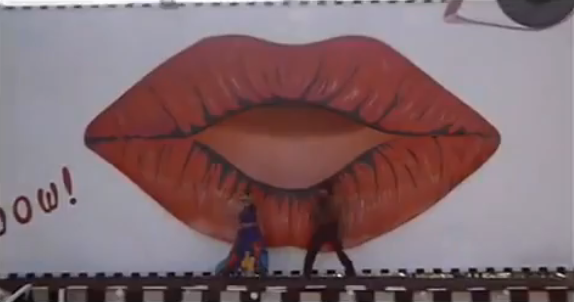
Whose lips do you think he mentions here? Kajol's? Think again: this is exactly when he utters those lines:
And all along I was wondering what that poster was doing inside a farm. Stupid me. How could I have ever thought that there exists a prop without a purpose?
Ik munda meri umar ka (video here)
Initially this seemed to be a very straightforward song of seduction. Rakesh Roshan was possibly speaking on behalf of all Indian apparel manufacturers: even if the girl concerned is Mamta Kulkarni, even if the voice is that of a 65-year old Lata Mangeshkar, the tune is incredibly monotonous and the lyrics are the flattest ever, you just need to shift to Indian outfits to woo an apparently disinterested man. If that's not patriotism for you, what is?
That's not all, though. For aspiring biology students, Rakesh Roshan has put up a lesson of sorts: what if the poor kids are not aware where the human heart is? The director cleverly uses the song for some basic physiology lessons:
 |
| "dilon ki ye baaten nahin jaanta"... why the plural, though? |
However, all discussion about this masterpiece remains incomplete without the two soccer references. This was 1995, and what happened in 1994? Have a look at Mamta Kulkarni's outfit above, check out the IFA shield winners
here, and check this out:
And on a much larger note, who won the 1994 soccer world cup? Now check this scene:
And compare to this:
Two homages paid. In one song. Priceless. Simply priceless.
Sooraj kab door gagan se Part II (video here):
I have always loved when a song has multiple versions in a movie. Traditionally the slower version used to appear with the word SAD, inside parentheses, next to it. This, strangely, though slower than its parent version, is also the happier one in the context of the movie.
Not much to say here, other than the obvious reference to Mahabharat: in their previous lives both brothers had earrings: this time only one of them has a kundal on. Guess who?
Bhangra pa le (video here):
Yes, Raakhee, dressed in new attire, puts
tilak on the foreheads of her sons.
Are they going to a war? No, guys. They're going to sing
bhangra pa le. I did sit up straight in my comfortable balcony seat. This is going to be serious stuff, I thought.
No, that isn't what the pathbreaking song is all about. This stretches even further, beyond the fact that they had used the synonymous and homophonous
jindri instead of
zindagi (oh, the genius!).
We get back to
Mahabharat again. The brothers get to share a woman (or whatever they get of her), mostly because one of them has his woman abducted. Welcome to the the ancient brothers-on-one-leg-lift-her-lehenga dance:
We also get a flashback during the song. It's not uncommon, but in this case, well, Shah Rukh is reminded of
jaati hoon main during the song: I do not typically think of other songs while singing one, but then, that's what separates Bollywood superstars from us, isn't it?
And then, as things start warming up, both heroes draw swords. I'm shocked: are they going to re-enact that
Zorro thing from the
sooraj kab door gagan se? Then the lyrics stream in:
sachchai ko kaat sake, aisi koi talwaar kahaan? Magical.
And in case you've missed it, note the East Bengal colours.
Genius. Sheer genius.
Mujhko Rana ji maaf karna (video here):
Bollywood has come a long way over the years. However, the one thing that I
really miss in them are court-scenes. This song made me relive those long-lost court-scenes from the 1960s, 1970s and 1980s. If you do not believe me, just scan through the lyrics
here. No
objection milord, no
order-order, no
taaziraat-e-Hind dafa 302 ke tahat, no nothing: just dismissal of a case for adultery through a song.
Who said Bollywood lyrics was on the decline? Morons.
There is also the array of emotions Amrish Puri has displayed throughout the song. The sheer range shows his portrayal as a connoisseur of Rajasthani folk music depicting court-scenes, and in the end he starts participating, first in the
gup-chup, then in an eerie lantern dance, and then in an all-out jig. Not only does the great man participate himself, but he gets the rest of the gang to join in as well.
 |
| I'm not sure which one displays ecstasy most accurately, but the emotion is unmistakable: that's how connoisseurs react at Dover Lane every year |
 |
| The gup-chup dance; even Ranjeet cannot resist it |
 |
| The lantern dance: look how the connoisseur and his team form a queue |
 |
| Yayness! |
And in case it's not evident from the last two pictures dance, the song features Feroz, the person who had played Arjun in B R Chopra's television saga (they're simply too obsessed about the epic, it seems). Here's a close-up:
 |
| The other Arjun |
Epic stuff. Literally.
Jai Ma Kaali (video here):
This is one of the most informative songs ever.
For example, there are massive (humongous would be a better word) Kaali temples in Rajasthan with waterfalls inside them. Since the village doesn't seem to have electricity, it's very likely that the falls are natural. Thanks for the knowledge on geography, Mr Roshan: it's not everyday that you come across a waterfall in the rugged topography.
Then again, we get to see the brethren, clad in harem-style-dhotis, vest-like jackets with black diagonal stripes and uber-smart bandanas, complete with camouflaging war-paint on their faces. This, again, is accepted as perfectly normal attire for Shyamasangeet practitioners in Kaali temples in obscure Rajasthani villages:
As an addition to the Wikipediaesque knowledge base that the song is, Rakesh Roshan also teaches us a four-step process to win back the woman you love from her captors, however powerful:
 |
| Step 1: Walk past the girl |
 |
| Step 2: She stands up |
 |
| Step 3: She takes a step backwards |
 |
| Step 4: Mission accomplished; now continue with the song |
The dumbstruck audience doesn't really have an option but to pray, demand or grumble for a sequel to arrive. They might as well utter
mere Karan Arjun phirse aayenge.